




What Is Power Factor (PF) in LED Lighting & Why It Matters for Commercial Projects
For commercial lighting contractors and project buyers, a finished installation may seem perfect until the electricity bill arrives with extra surcharges. This trouble often comes from one overlooked parameter on LED driver datasheets: power factor (PF). Many suppliers only focus on brightness and price during RFQ, while ignoring the risk caused by low power factor in large-scale lighting layouts.
What Is Power Factor for LED Lighting?
Power factor shows how effectively your LED fixtures convert grid power into usable light. It is the ratio of active power that actually works for the LED chips, against the total power drawn from the mains supply.
The value ranges between 0 and 1. When PF is close to 1, nearly all incoming electricity is converted for lighting. If PF stays low, a large portion of power becomes reactive power that does not produce light, but still loads the local power grid.
LED fixtures cannot work directly with AC mains. The internal LED driver converts alternating current into direct current, and the driver circuit design is the core factor determining the power factor performance of the whole luminaire.
High PF and Low PF LED Drivers: Not One-Size-Fits-All
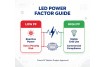
High PF Driver (PF ≥0.9) High power factor drivers suppress reactive power. They are engineered for projects with a large number of lamps running at the same time. Fit for: Retail stores, supermarket lighting, multi-floor offices, hotel public areas, large warehouses. Core benefit: Comply with most regional electrical acceptance standards, reduce grid burden and avoid reactive power penalty charges from power authorities.
Low PF Driver (PF <0.7) Low PF drivers have simpler circuits and lower manufacturing costs. They are mostly designed for small-volume residential decorative lighting. Fit for: Small home spotlights, low-watt accent lights with limited quantity. Risk note: Do not deploy hundreds of low PF lights in one commercial site. The accumulated reactive power will trigger grid overload warnings and extra fees.
Critical Mistake: Power Factor Determines Brightness
Lots of new buyers hold this wrong idea when comparing LED samples. Power factor has zero relation to lumen output and brightness. Two LED lights with identical wattage, same LED chips and same optical lens can have different PF readings. PF only describes power usage efficiency, not light output. Brightness is decided by chip quality, rated wattage, CRI and beam angle instead.
When Commercial Lighting Projects Must Check PF Strictly
Different regions and tender specifications set PF limits for lighting systems. You need to pay extra attention if your project falls into these categories:
- Large retail renovation projects and supermarket lighting upgrades
- New construction or refit of offices, schools and medical facilities
- Industrial warehouses with dozens or hundreds of high-power LED lamps
- Public lighting projects requiring official electrical inspection and sign-off
Inspectors will ask for PF test records during acceptance. It is much cheaper to verify PF in the RFQ stage than to replace batches of lamps after installation.
Practical RFQ Questions to Send to Lighting Suppliers
Add these points in your inquiry to lock down PF performance:
1.What is the tested power factor of this fixture under full load?
2.Can you provide an official test report showing PF data?
3.Will the power factor drop when the fixture works on a dimming system?
4.Does this model satisfy local grid and tender PF requirements for commercial sites?
Dimmable LED systems are especially tricky. Some drivers maintain good PF at 100% brightness but see obvious PF drop at low dimming levels, which is easy to miss in simple spec checks.
Wrap-up
Power factor is more than a number on a specification sheet. It ties closely to project acceptance and long-term operating cost. For most commercial lighting RFQs, verifying high PF performance helps you steer clear of unexpected fines and rework.
If you are sourcing compliant LED lights for your upcoming commercial project, share your site layout and requirements in the RFQ. Our lighting team will match proper fixtures and supply complete technical documentation.
Search Articles
Blog Categories
Latest News
What Is Power Factor (PF) in LED Lighting & Why It...
For commercial lighting contractors and project buyers, a...
What Is LED Driver? Types & How to Select the Right...
If you have sourced LED lights for retail, office or...
What is LED Flicker? How to Check Flicker for Commercial...
What Is LED Flicker? How to Check Flicker for Commercial...


