



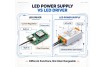
LED Power Supply vs LED Driver: What’s the Difference for Commercial Lighting Projects
If you often communicate with LED lighting suppliers, you may notice many buyers mix up the terms LED power supply and LED driver. Some people think they are the same thing, but using the wrong one in your commercial lighting project will cause flickering, overheating, premature light decay or even total lamp failure.
Understanding the difference between LED power supply and LED driver helps you send accurate RFQs and avoid costly on-site rework.
What is an LED Driver?
An LED driver is a dedicated power control unit designed specifically for LED chips. LEDs cannot work directly on mains AC power, because LED diodes are sensitive to current fluctuation.
LED drivers regulate constant current or constant voltage for LED chips. It stabilizes the output current, protects LEDs from current surges and maintains consistent light output. Most LED drivers are built inside luminaires, such as COB spotlights, recessed downlights and magnetic track lights.
What is an LED Power Supply?
LED power supply is a general AC-DC converter. Its main job is to convert high voltage alternating current into low voltage direct current.
Unlike LED drivers, standard LED power supplies are not specially tuned to protect LED chips. It just provides stable DC output for a group of low-voltage lighting devices. LED power supplies are usually installed externally, commonly used for LED strip lights, linear lights and multi-light centralized power systems.
Typical Application Scenarios
LED Driver
- COB spotlights, recessed downlights
- Magnetic track lights, MR16 / GU10 lamps
- Small integrated LED luminaires for retail, office and hospitality projects
LED Power Supply
- Low voltage LED strip lights
- Linear lighting systems
- Long runs of multiple low voltage lights with centralized power feeding
Common Mistakes Buyers Make
1.Treat LED power supply and LED driver as interchangeable parts. A general power supply cannot replace a constant current LED driver for COB lamps.
2.Only check voltage rating and ignore constant current / constant voltage requirement.
3.Overload the power unit by connecting too many lights on one output, triggering overheating and shutdown.
4.Forget surge protection requirements for outdoor or industrial lighting sites.
Procurement Checklist Before Sending RFQ
1.Confirm your light source: Does it need constant current or constant voltage?
2.Check total wattage and keep 20% power margin for safety.
3.Indoor or outdoor? Confirm IP rating if installed in wet areas.
4.Check dimming compatibility if your project needs dimming function.
5.Verify surge protection level for commercial and industrial sites.
Conclusion
LED driver is a specialized regulator for LED chips, while LED power supply is a general AC-DC converter. They are not interchangeable.
When you prepare your lighting specification list, clearly state whether you need LED drivers or LED power supplies. This simple step reduces miscommunication with manufacturers and prevents unexpected failures after installation.
Search Articles
Blog Categories
Latest News
LED Power Supply vs LED Driver: What’s the Difference...
If you often communicate with LED lighting suppliers, you...
What Is LED DALI Lighting? A Buyer’s Guide for...
When it comes to smart lighting control for large commercial...
What is LED Bin Sorting? Why LED Binning Matters for...
When you place a bulk commercial lighting order, one of the...


