



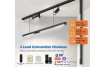
How to Calculate the Maximum Load of 48V Magnetic Track Power Supply
If you’ve been on site and seen 48V magnetic track lights flickering, cutting out randomly or even burning out the power supply, nine times out of ten it’s a load matching mistake. A lot of installers just add up all the lamp power roughly and pick a driver, and this quick check creates plenty of headaches once installation finishes.
48V magnetic track lights work on constant voltage. The math itself is simple, but there are a few practical rules you have to follow on real projects.
Basic load rule
Total wattage of all magnetic light modules must be less than the rated output of your power supply.Total power = add up every spotlight, linear light, pendant lamp and grille light on the same track circuit
One key point: never run the power supply at 100% of its rated power. For site safety and long service life, we advise keeping the actual load at 75%–80% of the driver’s rating. This spare capacity helps handle heat build-up, voltage drop along the track and the small current spike when you switch the lights on.
For example: A 200W 48V power supply should only run a maximum of 150W to 160W worth of lights. Don’t push it close to 190W or 200W.
Don’t forget these items when adding up power
1.Every magnetic fitting on the same circuit: spotlights, linear strips, pendants and grille lights all count.
2.Voltage drop on longer tracks. If your track run is over 6 meters, the voltage will drop towards the far end. You either reduce the load or add a second feed point.
3.Smart accessories take power too. Zigbee gateways and dimming modules draw a small amount of power; factor these in for larger commercial jobs.
Three common mistakes we see all the time
1.Using the marketing wattage instead of real tested power Some catalogues label a spotlight as 12W, but the actual power draw is higher. Always check the datasheet’s tested power figure instead of the headline number.
2.One power supply feeding multiple long track sections When the furthest light sits far away from where the power connects, voltage drops. The lights at the end get dim or start to flicker.
3.Mixing 220V and 48V modules on the same track This is a critical error. High voltage and low voltage magnetic parts cannot share the same track. It will destroy all your lights right away.
Quick checklist you can send us for quotation
- Total length of each magnetic track
- Model and quantity of every magnetic light module
- Single-end feed or dual-end power feed
- If dimming or Zigbee smart control is required
- Distance from the power input point to the last light fitting
FAQ
Q: Can we use two power supplies for one long curved magnetic track? A: Yes, dual feeding is the standard fix for long runs. Split the lights evenly so each power supply carries a balanced load. Q: What happens if we overload the 48V power supply? A: Flicker is usually the first sign. Then the driver will heat up and trigger protection, shutting the lights off. If left overloaded continuously, the power supply will fail permanently. Q: Do I still need to stick to the 80% rule for small home projects? A: It’s still good practice. Home lighting often stays switched on for hours each day, and heat builds up slowly over time.
If you are working on a new magnetic lighting layout, send over your light list and track drawing. We can review the power supply selection and load balance before you start installation.
Search Articles
Blog Categories
Latest News
How to Calculate the Maximum Load of 48V Magnetic Track...
If you’ve been on site and seen 48V magnetic track...
Why 48V Magnetic Track Light Flickers After Installation...
If you just finished installing a 48V magnetic track...

6-Wire Track Rail: Solve Your Complex Commercial...
If you’ve ever worked on commercial lighting projects,...


