




2-wire vs 3-wire track rail: which one for your retail project
If you source standard track rail for retail, café and shop renovation projects, you have definitely met this question: should I pick 2-wire or 3-wire track rail? Many buyers only check price and place orders, then find the track cannot pass local inspection, or the spotlights cannot fit properly.
These two are both single-circuit track systems. It does not mean 3-wire supports separate zone control. This is the most common misunderstanding among contractors and new importers.
What is 2-wire track rail
2-wire track rail contains two copper conductors: live and neutral. There is no earth line inside the aluminium profile. All lights mounted on one track run turn on and off together. No group switching.
✅ Suitable scenarios Budget small retail shops, pop-up booths, temporary exhibition stands, projects in markets with loose earthing requirements.
⚠️ Risks you need to know Without protective earth, it fails commercial electrical inspection in EU, UK and Australia. Do not submit 2-wire track for these formal tender projects. Adapter selection is limited. You must use 2-contact track heads.
What is 3-wire track rail
3-wire track rail adds one dedicated earth wire, based on live + neutral. It is still single-circuit, all lights share one switch. The extra wire is only for safety grounding, not for independent lighting control.
✅ Suitable scenarios Most commercial retail projects, clothing stores, small galleries, permanent shop fit-outs for EU, AU and many Southeast Asian markets. It matches most standard track spotlights on the market.
⚠️ Risks you need to know A lot of customers mix up 3-wire track with 3-circuit multi-control track rail. If your client needs separate control for window lighting and shelf lighting, 3-wire cannot do that. You will need 4-wire 3-circuit track instead.
Quick comparison
Conductors 2-wire track rail: Live + Neutral 3-wire track rail: Live + Neutral + Earth
Ground protection 2-wire track rail: No 3-wire track rail: Yes
Circuit 2-wire track rail: Single circuit 3-wire track rail: Single circuit
Market restriction 2-wire track rail: Not for EU/AU commercial projects 3-wire track rail: Meets mainstream safety standards
Cost 2-wire track rail: Lower 3-wire track rail: Slightly higher
Compatible fixture 2-wire track rail: 2-contact track heads 3-wire track rail: 3-contact grounded track heads
Buying checklist before sending RFQ
1.Confirm the destination country electrical standard first. EU commercial projects almost always require 3-wire grounded track.
2.Check existing track heads or samples. Track rail and adapters must match contact layout.
3.Calculate total load. Keep total wattage below the track rated limit.
4.Clarify with your client: do they need separate lighting groups? If yes, skip 2-wire and 3-wire, quote 4-wire multi-circuit rail.
5.Confirm surface finish: black, white or silver, same as your track lights.
Common mistakes buyers make
- Think 3 wires = 3 separate control circuits.
- Use 2-wire track for EU commercial projects and get rejected on site inspection.
- Mix 2-wire adapters with 3-wire track, cause poor contact and flickering.
- Ignore maximum load, install too many spotlights and overheat the rail.
FAQ
Q: Can I upgrade 2-wire track to 3-wire later? A: No. The internal copper bar structure is different. You cannot add earth wire on site.
Q: Are 2-wire and 3-wire track rails same profile size? A: Many manufacturers share the same outer aluminium extrusion, but internal copper contacts differ. Do not assume adapters are interchangeable.
Q: Which one is more popular for bulk stock? A: 3-wire grounded track rail is our main selling item for regular commercial wholesale orders.
Search Articles
Blog Categories
Latest News
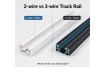
2-wire vs 3-wire track rail: which one for your retail...
If you source standard track rail for retail, café...
24V vs 48V Magnetic Track Lighting: Which One For Your...
24V and 48V magnetic track lights are both SELV low-voltage...
Voltage Drop on 48V Magnetic Track Lighting: How to...
If you have worked on long magnetic track projects, you have...


